 Pink Elephant Blog


Configuration Management – A Rose by Any Other Name
As I prepare to teach a class on service configuration management, I find myself reflecting on one of the challenging aspects of the English language. Specifically, that we can use the same word with the same spelling to mean different things depending on the context.
For grammar geeks, the technical term for this is called a homonym.
Some examples of homonyms from yourdictionary.com include:
- Address - to speak to/a location
- Bark - a tree's out layer/the sound a dog makes
- Bright - very smart or intelligent/filled with light
- Current - up to date/flow of water
- Kind - type/caring
- Mean - average/not nice
- Stalk - a part of a plant/to follow or harass someone
Adding to this challenging linguistic quirk, we also have words that are spelled the same and can be used as both a noun as well as an action or verb. For example:
- Google - the organization (n)/to search the web for information, or to google something (v)
- Die - the singular form of dice (n)/to die, or cease to function (v)
The reason I’m writing this article, is that in a few days, I will need to describe the term “configuration management” as both a verb and a noun to the students in my class.
In today’s modern IT world, we use the phrase configuration management in different contexts, including as:
- A noun (the current configuration): What is the current configuration of an asset, device, or end-to-end service model
- A verb (to configure): The act of configuration via orchestration, provisioning and deployment tools
- An artifact (the standard configuration): Software configuration, the old use of the term, which is now known as trunk management in DevOps lingo, focuses on documenting and storing software artifacts that are version controlled and refer to an actual instance of a script we house as code in a software repository
It gets even more confusing because we need to use all of these applications of the word “configuration” together in the same discussion.
Here are some examples of how all three concepts work together:
- Software orchestration, provisioning, and deployment: We configure (verb) a device (physical/virtual) based on a standard configuration script (artifact) and then capture that configuration (noun) in an asset or configuration management database (CMDB) repository.
- Compliance assurance: We need to validate that our environments meet regulatory requirements and audit controls by using only our standard configuration scripts (artifact) for automated device and environmental configuration (verb) and then be able to report on our current configuration (noun).
- Identifying configuration drift: Configuration drift happens when production or a primary hardware and software environmental configuration “drift” or become different in some way from an authorized standard version, or different from a secondary service continuity environment.
To understand if you have drift you must be able to compare the current configuration of an object or device as discovered by a monitoring tool (noun) to the standard or baseline configuration record in the CMBD (different noun). If drift is indeed discovered, you need to re-configure (verb) the device/environment using the standard configuration script (artifact) with your configuration management toolchain. Anyone have a headache yet?
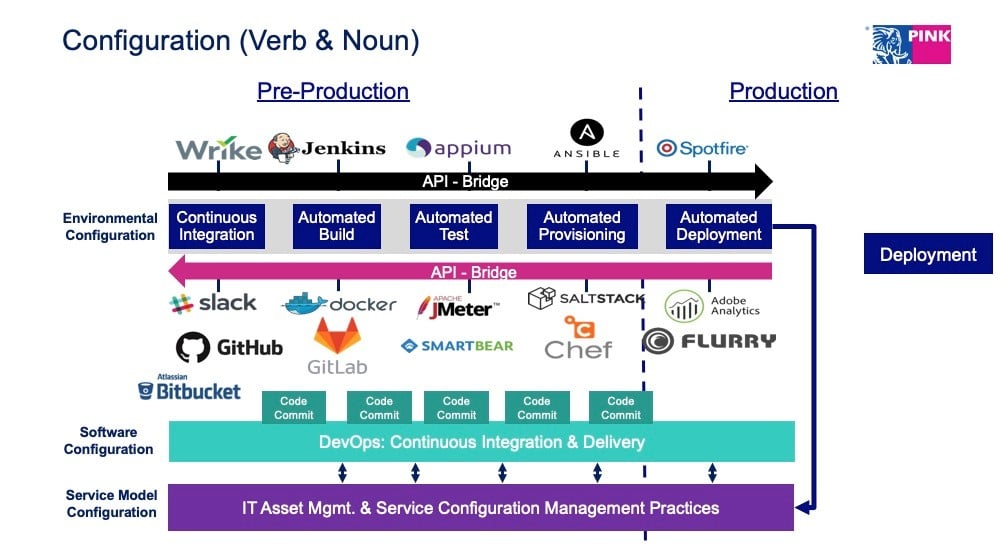
In summary, this is the crazy IT service management life we all get to enjoy every day.
Context Is everything!!
Troy’s Thoughts What Are Yours?
For more thoughts on Configuration Management check out this classic Pink Practitioner radio podcast: Geeking Out on CMDB Object Models
“I do not fear truth. I welcome it. But I wish all of my facts to be in their proper context.” – Gordon B. Hinckley
Like this article? 
Comments
Really informative article, I had the opportunity to learn a lot, thank you.
https://www.thetradevision.com/
Trade Vision | September 28, 2022 at 12:50am