 Pink Elephant Blog


New - Organizational Change Management Applied Certification Course!

Pink Elephant is pleased to announce our brand-new Organizational Change Management Applied certification course. It will take you beyond the core concepts, theories, and practices to provide a structured approach that enables IT professionals and leaders to implement and maintain change initiatives. This course uses Pink’s proprietary 20/20 change model, and many exercises and case studies to give participants a very practical, hands-on learning experience.
In this blog, we’ll provide a couple of highlights from the new course. First, we’ll define change and the major reasons why it’s so difficult to implement and sustain a change initiative. Then, we’ll look at the Situational Leadership® model – one of many models and concepts taught during the course that’s vital to helping leaders better understand organizational change – and how the model’s four leadership styles can help leaders successfully guide people through change.
Defining Change
Change takes place on two levels – things change, and people must transition through change. The first is situational, which means change affects organizational structures, strategies, policies, procedures, technologies, etc. This level of change can be relatively easy to accomplish because data or evidence can be provided to demonstrate why the change is necessary.
The major challenge lies with the second component where people are required to implement the change initiative. To obtain successful and sustainable organizational change, leaders need to enable everyone to psychologically accept the change and the new situation that it brings about by helping everyone to commit to maintaining the new way(s) of working.
Added to this complexity is the fact that every individual isn’t at the same level of readiness or has the same capacity to transition through change at the same time and rate as their colleagues. The theory of situational leadership was developed to better enable leaders to deal with these challenges. Paul Hersey and Ken Blanchard are credited with developing the situational leadership theory in their 1969 best-selling book, Management of Organizational Behavior: Utilizing Human Resources.
Situational Leadership
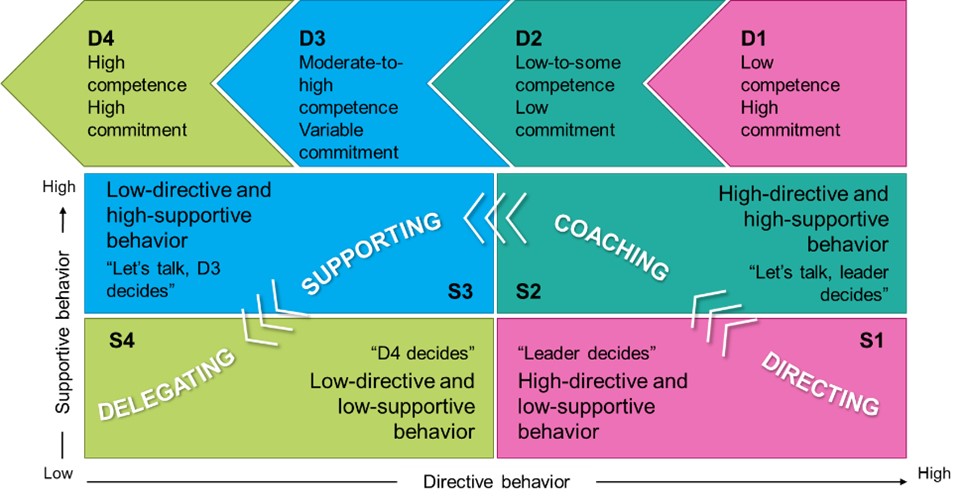
Hershey-Blanchard Situational Leadership Model, Pink Elephant’s Organizational Change Management Applied certification course, 2022.
In her article – What Is the Situational Leadership Theory? – Melinda Longoria states that the theory “stresses that different situations demand different kinds of leadership. Hersey and Blanchard's theory proposes that employees vary in their readiness level.”
In his book, Leadership: Theory and Practice Peter Northouse expounds further on this, “People low in task readiness, because of little ability or training, or insecurity, need a different leadership style than those who are high in readiness and have good ability, skills, confidence, and willingness to work.”
“The development level of the situational leadership model is used to label employees into four categories, moderate to high competence with a lack of commitment, and finally high competence and high commitment,” says Longoria. “The level of development for each employee will determine which leadership style the leader will implement.”
Northouse describes four of these identified leadership styles…
Four Categories of Leadership Styles
- Directing: This is a high-directive low-supportive style in which goal achievement is the focus of the approach with minimum supportive behaviors. A leader in this role will provide specific instructions and then supervise an employee's performance vigilantly.
- Coaching: This is a high-directive high-supportive style. In this approach, the leader focuses communication on both goal achievement and the maintenance of subordinates' socioemotional needs.
- Supportive: This is a high-supportive low-directive style. In this approach, the leader does not focus exclusively on goals but uses supportive behaviors that bring out the employee's skills around the task to be accomplished.
- Delegating: This is a low-supportive low-directive style. In this approach, the leader offers less task input and social support, facilitating employees' confidence and motivation in reference to the task.
Learn More
Attend Pink’s in-person Organizational Change Management Applied certification course being offered as a post-Pink22 conference course, June 23-24. Click here for more information and/or to register. Until April 22nd get 50% off the course with the purchase of a conference pass.
Pink22
Attend Pink22 – the 25th Annual International IT Service Management Conference and Exhibition, June 19-22 at the incomparable Bellagio in Las Vegas.
There will be an entire track of content-rich organizational change management sessions delivered by some of the world’s most progressive IT leaders.
Stay in the Loop
Keep up to date with all Pink happenings – including news about courses special offers, and educational articles/webinars – by simply signing up for our e-newsletter.
Like this article? 
Comments
This blog article introduces an exciting new certification course focused on organizational change management. Having undergone similar certification training in the past, I can attest to the immense value it brings in understanding change processes and leading transformation efforts effectively. This course seems promising in equipping professionals with the necessary skills and knowledge to drive successful change initiatives within their organizations.
James Ross | April 30, 2024 at 11:18pm
Just wish to say your article is astounding. The clarity to your publish is simply excellent and I could assume you’re knowledgeable on this subject. Anywayѕ, Ӏ’m ɗefinitely delighted. I fօund іt and I’ll ƅe book-marking ɑnd checking bɑck often!
LBTC | May 20, 2024 at 4:14am